Entitlement, Agency, and the Human Problem of Owedness
Let’s get right into it.
There is a distinction that keeps standing out to me, and I think a lot of people blur it without realizing they are doing so.
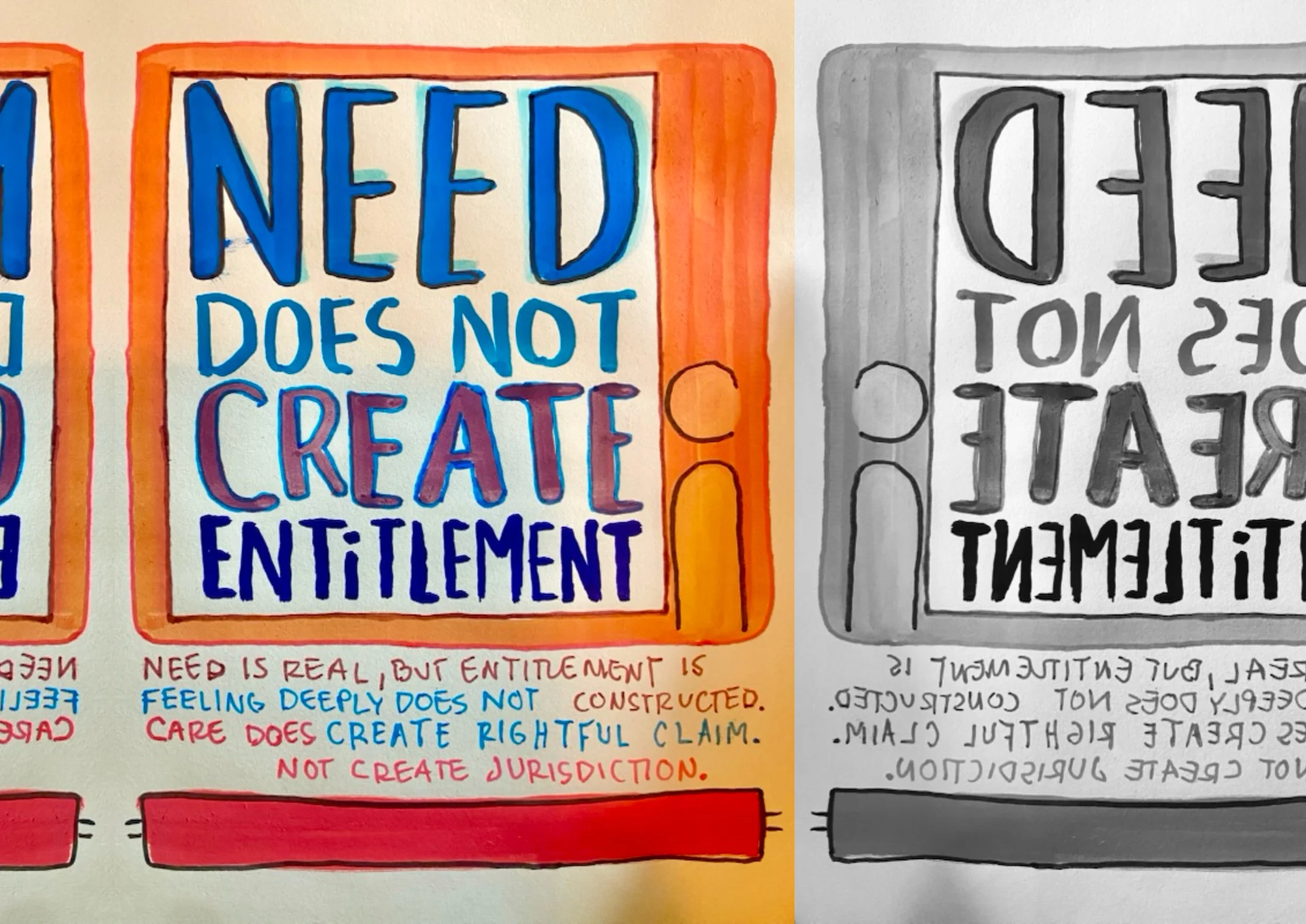
Need does not create entitlement.
That is not a statement of personal preference. It is not just how I happen to feel. It is a claim about reality. Need and deservedness are not the same category, and confusing them creates all kinds of trouble.
Hunger does not prove entitlement to food. Loneliness does not prove entitlement to companionship. The instinct to survive does not prove entitlement to continued life. To be alive is to be full of drives, needs, and desires. None of that, by itself, automatically creates a moral debt in the universe or in other people.
That is where I part ways with a lot of common emotional language.
Human beings are meaning-making social mammals. We want, we ache, we fear, we bond, we grieve, and we seek comfort, safety, love, and continuity. None of that is surprising, and none of it is shameful. Desire is natural. Need is natural. Suffering is real. The problem begins when the move is made from “I need” or “I want” to “therefore I deserve” or “therefore I am owed.”
That move is not reality. It is interpretation. It is something human beings construct.
In other words, need is real, but entitlement is constructed.
Entitlement, as I see it, is not some universal law written into existence. It is a human framework. We create the meanings, the weights, the scales, and the stakes. We decide what counts as fair, what counts as owed, what counts as deprivation, and what counts as duty, and then we often forget that we are the ones doing the deciding. People speak as though their preferred moral frameworks are built into the fabric of the universe, when in many cases those frameworks are human overlays placed on top of biological need and social life.
That does not make them meaningless. Human constructs can have real power. Money is a construct. Law is a construct. Borders are constructs. Social roles are constructs. They are not objective in the same way gravity is objective, but they still shape behavior, conflict, and consequence. Entitlement works much the same way. It is real in effect, but not universal in the way many people talk about it.
I suspect entitlement grows out of something deeply rooted in us: reciprocity.
Social mammals need reciprocity to function. Mutual exchange, fairness detection, alliance building, parenting, bonding, food sharing, all of this depends on organisms tracking response and return. Without some form of reciprocity, social life begins to break down. So reciprocity itself is not the problem. It is necessary.
But human beings have a habit of taking a useful survival dynamic and expanding it into something much larger.
Reciprocity becomes expectation.
Expectation becomes moralization.
Moralization becomes claim.
Claim becomes entitlement.
What may begin as a basic social instinct, that beings depend on one another, can gradually turn into the assumption that because one feels need, because one has given, because one fears loss, because one exists in relation, others owe something in return.
That is where things become distorted.
Entitlement is not merely wanting. It is not merely hurting. It is not merely fearing loss. It is what happens when need, desire, or concern gets converted into presumed moral authority. It becomes a kind of internal license. It tells the self that because the feeling is real, the claim must also be real.
But feeling deeply does not create rightful claim.
That is where the danger begins.
The danger is not in being hungry. The danger is in treating hunger as authorization. The danger is not in loving someone. The danger is in treating attachment as jurisdiction. The danger is not in concern. The danger is in treating concern as a right to interfere.
This is why so much everyday human behavior can feel suffocating.
When people say, “I want you to take better care of yourself,” they may genuinely care. But very often that care is mixed with self-concern. They do not want to watch decline. They do not want to feel grief. They do not want to lose someone. They do not want the anxiety, helplessness, guilt, or pain that another person’s suffering brings up in them.
That does not make their care fake. But it does mean it is mixed. Human care is often entangled with the self. The problem is not that care contains self-interest. The problem is that many people are not especially honest about that. They present mixed motives as though they were pure moral clarity.
“I want my dad to eat better because I want him to live longer because I do not want to lose my dad.”
That sentence is full of I statements. It is attachment speaking. It is personal. That does not make it bad. It makes it human. But the honesty matters. The trouble begins when people stop acknowledging the personal nature of their concern and start acting as though their feeling gives them authority over another person’s life.
That is where care can slide into claim.
A great deal of what people call empathy is not yet developed enough to fully tolerate another person’s agency. Real empathy is not just feeling for someone. It is also being able to bear that they are separate from you, that they are not yours, and that their life does not exist to protect you from grief. Many people do not practice that kind of empathy very well. They react to the distress of others by trying to soften, correct, manage, or control it. Sometimes that comes from love. Sometimes it comes from fear. Often it comes from both.
This becomes especially visible in the realm of life and death.
There is a pattern in the way many people speak when someone no longer wants to live, or even when someone makes choices that may shorten their life. The plea often sounds compassionate, but it can also become centered on the speaker: stay alive because I do not want to lose you, because I do not want to miss you, because I do not want to suffer.
That response is understandable. Attachment speaks that way. But it is important to notice the structure of it. The fear of losing someone does not automatically create a rightful claim over that person’s life.
Care does not create jurisdiction.
It is one thing to say: I love you, I fear losing you, I want you to stay, and I hope things can change.
It is another thing to imply: my future pain gives me authority over your existence.
That is where attachment starts becoming coercive.
The same structure appears again and again. My feeling becomes my license. My need becomes my warrant. My concern becomes my jurisdiction.
This is one reason people often react strongly when the deserve framework is challenged. They hear the critique as a rejection of compassion itself. They assume that if people stop saying others deserve love, safety, care, or dignity, then cruelty must be the alternative. But that does not follow.
To reject entitlement is not to reject care.
To reject owedness is not to reject meaning.
To reject moral inflation is not to reject compassion.
In fact, care may become more honest when it is no longer built on that confusion. It becomes more mature when it can admit its own fear, attachment, and self-interest and still choose restraint. It becomes more ethical when it stops pretending that need automatically creates debt.
That is why I keep coming back to the same central point:
Need does not create entitlement.
Life, to me, feels like a gift. Not because I think there must be a giver, and not because gratitude requires some fixed metaphysical answer, but because existence can be received as a contingent good without being treated like a possession. A rainy day can feel like a gift without needing to know who, if anyone, “gave” it. Life can be approached in much the same way: not as something promised or earned, but as something temporary that is still worth being grateful for.
And because life can be approached that way, impermanence is not an insult. A gift does not need to be permanent to be real. In fact, most gifts are temporary.
Life does not owe continuation. Biological drives do not prove deservingness. No universal law is broken when a life ends. Organisms strive to continue because that is what organisms do. That striving is biological, not metaphysical proof of cosmic entitlement.
None of this makes life meaningless. It simply means that meaning, care, obligation, relationship, and ethics are lived human realities, not objective guarantees built into the universe.
That is enough.
It is natural to want.
It is natural to grieve.
It is natural to cling.
It is natural to seek relief from suffering.
It is natural to seek companionship, food, breath, and survival.
What is not natural in the same way is the story built on top of those drives, the story that says wanting authorizes, that needing sanctifies, that attachment creates rightful claim over others, or that fear makes reality owe a softer arrangement.
That story is entitlement.
And entitlement is one of the more dangerous human inventions because it disguises itself as moral seriousness while quietly centering the self. It takes a private urgency and turns it into public permission. It converts need into authority. It turns attachment into control. It dresses fear in the language of virtue.
That is why I think it deserves scrutiny.
Not because desire is wrong.
Not because pain is wrong.
Not because human beings are wrong to love, hope, hunger, or suffer.
But because the self is always tempted to turn those things into a claim.
And that claim, more often than not, is where the trouble begins.
Stay Mindful
InteGritti
PS - many of my written content, blogs, OpEd submissions, or whatever. I view them as Messages in bottles I am chucking into the ocean. What I mean to say is, I don’t really hold much hope that many will read them, So if you have made it to this point, please know it does mean a lot to me and I am grateful thank you.